Visualforce to Lightning migration (WireBright)

Full scoping of a Salesforce Classic → Lightning migration: component inventory, a decomposed estimate (17 days), a per-component risk matrix, a tooled diagnostic, then a prototype of the two most critical components (LWC + Aura Quick Action).
Context
EG Manufacture, a tapestry manufacturer, managed its leads and accounts on Salesforce Classic. Two pieces blocked the move to Lightning Experience:
- a Visualforce page for opportunity search on the account record;
- a JavaScript button for lead status updates.
WireBright Consulting led the migration. The mission wasn't "re-code the app" but to scope the migration defensibly: technical and functional specifications, costed conversion options, a risk matrix — then deliver a first prototype of the two critical components.
Inventory & estimate
A credible migration estimate isn't a lump sum — it's decomposed:
| Item | Detail | Estimate |
|---|---|---|
| Visualforce page → LWC | Search + display of linked opportunities | 8 d |
| JS button → Aura Quick Action | Lead status update | 2 d |
| Existing Apex controllers | Upgrade for LWC / Aura compatibility | 2 d |
| Testing & validation | Sandbox, regression scenarios | 3 d |
| Deployment & QA | UAT, go-live | 2 d |
| Dev total | 17 d | |
| User training | ~7–8 h, including advanced admin training | outside dev |
Choosing the target tech, component by component
This is where the architecture judgment sits:
- Visualforce page → Lightning Web Component. A data-bound LWC (
@wire) is the right replacement for a search page: reactive, cached, aligned with the Lightning Design System. - JavaScript button → Aura component as a Quick Action. The JS button doesn't work in Lightning. Replacement goes through a Quick Action, and at the time of the project that action is carried by an Aura component (
force:lightningQuickAction), not an LWC. Choosing Aura here isn't a default — it's the platform constraint for this specific use case. - Apex controllers upgraded to serve both new components without breaking the data contract.
Delivered prototypes
AccountOpportunitiesSearch (LWC) — dynamic search field + lightning-datatable, wired via @wire to AccountOpportunitiesController.getOpportunities():
@AuraEnabled(cacheable=true)
public static List<Opportunity> getOpportunities(Id accountId, String keyword) {
    // SOQL keyword filtering over the account's opportunities
}
UpdateLeadStatus (Aura Quick Action) — force:lightningQuickAction + force:hasRecordId, calls LeadStatusController.updateStatus(), with a toast notification (notificationsLibrary) on error and automatic view refresh.
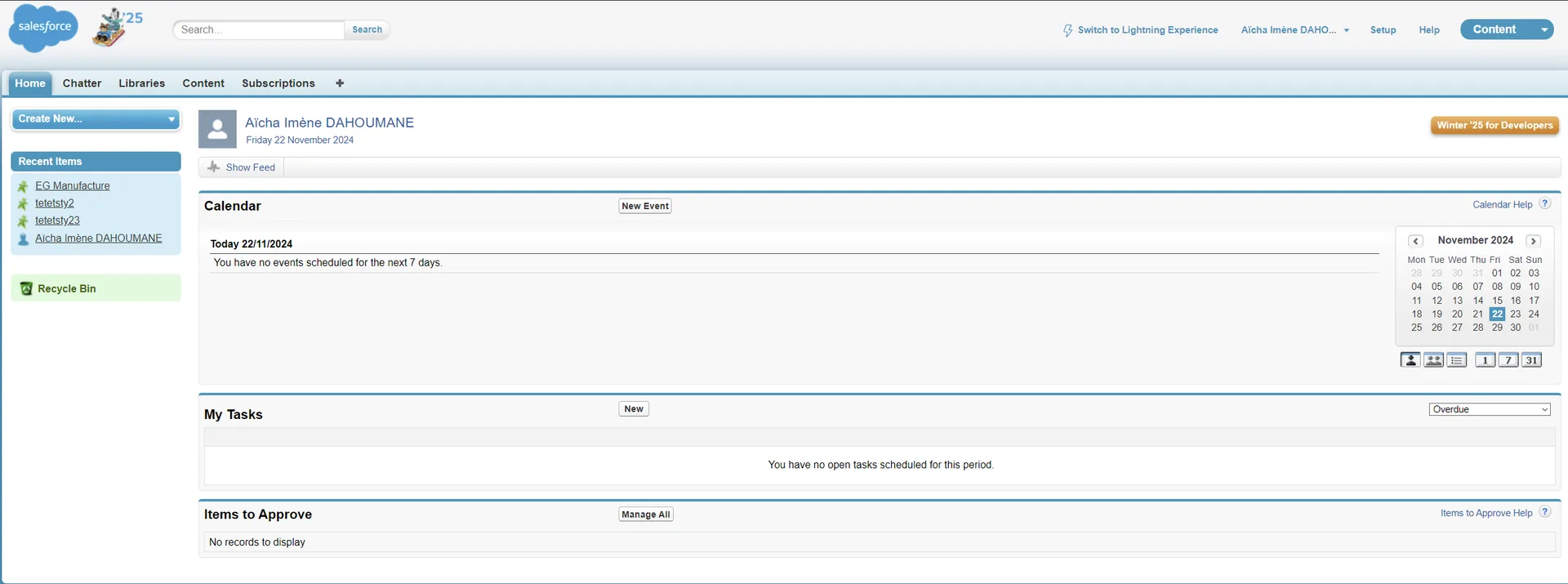
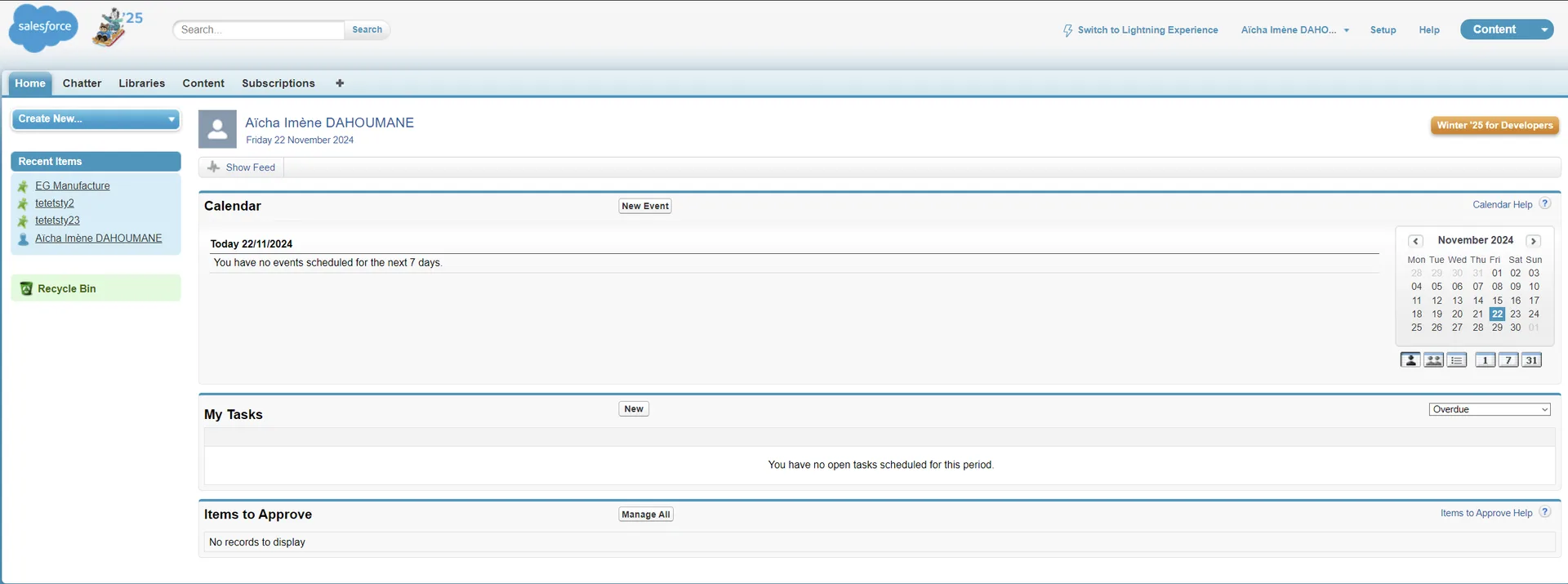
Side-by-side Classic vs Lightning screenshots across 3 screens (home, account record, lead record), documenting concrete UX gains: KPI widgets, no-reload quick actions, visual status path for leads.
Risk management
| Risk | Probability / impact | Mitigation |
|---|---|---|
| Apex controller incompatibility | Medium | Thorough sandbox testing + ongoing code reviews |
| Low user adoption | High probability | Training sessions (~7–8 h, incl. advanced admin) + support documentation |
| LWC performance | Low impact | Code optimization, cacheable=true |
Tooled diagnostic via the Lightning Experience Configuration Converter: 1 unconverted JavaScript button, 18 actions/buttons not yet deployed, 0 Visualforce pages requiring immediate action. The converter isn't a gimmick — it turns "we'll see at migration time" into a finite list.
Rollout plan & KPIs
- Post-migration KPIs: Lightning adoption > 90%, component response time tracked.
- Roadmap beyond the 2 components: Lightning reports, Flow automation, new LWCs — the migration is a starting point, not an end.
- Training: ~7–8 h, with an advanced-admin track to make the team self-sufficient for what follows.
Decisions & assumed limitations
| Decision | Alternative rejected | Why |
|---|---|---|
| Aura for the Quick Action | LWC | Platform constraint at the time: the "button" Quick Action is carried by Aura |
cacheable=true on the opportunity query | Non-cacheable query | Read-only, repeated search — client caching cuts round-trips |
| Decomposed estimate | Lump-sum quote | A migration quote is discussed line by line; a lump sum can't be defended |
| Prototype of the 2 critical components | Full migration in one pass | Prove feasibility and firm up the estimate before committing the 17 days |
Assumed limitations:
- 2 components prototyped, not the whole app — the value is in the quality of the scoping and the reliability of the estimate, validated by a working prototype, not in an end-to-end migration.
- Estimates not checked against actuals: 17 days is a substantiated estimate, not a measured time.
- Screenshots document expected gains, not measured post-adoption gains.
Results
| Metric | Value |
|---|---|
| Components prototyped | 2 (LWC AccountOpportunitiesSearch + Aura UpdateLeadStatus) |
| Decomposed project estimate | 17 dev days |
| Target Lightning adoption (tracking KPI) | > 90% |
| RNCP diploma evaluation | 2/2 competencies validated |
What this project demonstrates
Legacy migration discipline: a decomposed estimate that stands up to discussion, a risk matrix with mitigations, the right target-tech choice per component (and knowing why Aura over LWC here), a tooled diagnostic, and a rollout plan with KPIs. It's exactly what a client pays a consultancy for — scoping a migration credibly before committing a budget to it.
Fil-rouge project from the RNCP Level 6 "Développeur Concepteur Logiciel" diploma (OpenClassrooms): imposed context, components and constraints, deliverable defended before a jury. It is expanded here with the estimation / risk / tech-choice / rollout reading expected in a professional context — beyond the strict scope of the exercise.
Screenshots