Salesforce solution design (Tours For Life)
End-to-end Sales Cloud solution design for a travel agency: Prospect → Traveler conversion via Person Accounts, catalog / booking separation (Trip vs Purchased Trip), fleet management, 2 no-code Flows, North/South zone security — with an owned architecture retrospective.
Context
Tours for Life, a growing travel agency, wanted to digitize its commercial management end to end. The agency's president needed a Salesforce CRM covering the full cycle: prospect acquisition, conversion to travelers, trip management, and sales performance tracking by zone (North / South).
One need surfaced during scoping: managing the bus fleet directly in Salesforce, since a single bus can be assigned to several trips. It's the kind of late addition that tests how solid a data model is.
The data model
| Object | Role | Design choice |
|---|---|---|
| Prospect | Standard Lead, tab renamed | Phone required on entry — a prospect with no number isn't workable |
| Traveler | Account with Person Accounts enabled | Dedicated Record Type "Account to Traveler": lets you convert a prospect into an individual with no business account — the normal B2C case |
| Trip | New object — the catalog | Destination, departure/arrival, price, status, available seats |
| Purchased Trip | New object distinct from Trip — the booking | Links Traveler + Trip, luggage, seats purchased, bus number |
| Bus Fleet | New object | lookup to Trip — one bus, several trips |
The central modeling decision: separating the catalog (Trip) from the transaction (Purchased Trip). Merging the two would have duplicated trip data on every booking and made a simple "how many seats are left?" impossible. Two objects, one relationship, and capacity becomes a derived value again.
The no-code automation
Two Record-Triggered Flows, no Apex:
- Flow #1 — confirmation email automatically sent to the prospect when their status changes from "information gathered" to "interested".
- Flow #2 — automatic decrement of the "Available Seats" field on the Trip whenever a related Purchased Trip is created or updated.
The no-code choice is deliberate: two simple record-triggered rules, no bulk or async processing. Flow is the right tool here — Apex would be over-engineering. Knowing where no-code stops matters as much as knowing how to code.
The zone-based security model
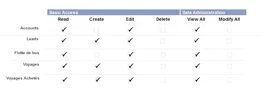
- 2 profiles: Sales Director (full access), Sales Rep (create/edit prospects, convert them, view travelers and purchased trips).
- 3 hierarchical roles: Sales Management → North Sales Rep / South Sales Rep — management sees both territories.
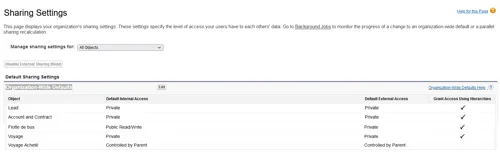
- Per-object OWD:
Privateon Prospect / Trip,Public Read-Onlyon Bus Fleet,Controlled by Parenton Purchased Trip. - Sharing Rules by role (North / South) on Prospect and Trip: territories are kept separate, with read-only visibility on the other zone's travelers.
The architecture retrospective
With hindsight, the one profile per level choice (Director / Sales Rep) isn't the most scalable. A single "Sales Rep" profile + a Permission Set granting director-level rights would be more maintainable: Permission Sets stack and can be audited, whereas an extra profile is one more divergence point to keep in sync on every change.
Naming this isn't downplaying the deliverable — it's showing that a decision gets revisited. A junior ships and moves on; the difference is going back to the choice.
Reports
| Report | For whom | What it drives |
|---|---|---|
| Available Trips (Status = Open) | Sales reps | Which offer to pitch, with price / seat totals |
| Prospects to Travelers | Sales + management | Conversion rate and date, by rep and role |
| Trips Purchased per Sales Rep | Management | Performance grouped by role (North / South / Management) |
Reports pinned to the Salesforce home page for daily use.
Decisions & assumed limitations
| Decision | Alternative rejected | Why |
|---|---|---|
| Person Accounts for Travelers | A Contact under a generic Account | Travelers are individuals; Person Accounts is Salesforce's B2C model |
| Separate Trip / Purchased Trip | A single Trip object carrying the booking | Catalog ≠ transaction: separates stable data from per-booking data |
Bus Fleet as a lookup to Trip | Master-detail | A bus outlives the deletion of a trip; no cascade delete wanted |
| 100% Flow automation | Apex trigger | Two simple record-triggered rules — no-code fits, Apex would be unjustified |
Assumed limitations:
- Person Accounts is an irreversible org setting. Enabled here knowingly, but it's a decision that commits the whole org — to validate with the client before, not after.
lookupon Bus Fleet: no automatic capacity roll-up summary on the Trip side (unlike the catalog's "available seats" field, driven by Flow). An overbooking check at the bus level would still need adding.- Solution demonstrated on sandbox, not proven at a growing agency's real volume.
Results
| Metric | Value |
|---|---|
| Business objects designed | 4 (Traveler Person Account, Trip, Purchased Trip, Bus Fleet) |
| Hierarchical roles | 3 (Management + North / South Sales Rep) |
| Flow automations (no Apex) | 2 |
| RNCP diploma evaluation | 4/4 competencies validated |
What this project demonstrates
Sales Cloud fundamentals done properly: Person Accounts for B2C, a data model that separates catalog and transaction, owned no-code automation where it's enough, a role- and zone-based security model. And an explicit architecture retrospective — proof that a choice gets questioned, not forgotten once the deliverable is handed in.
Fil-rouge project from the RNCP Level 6 "Développeur Concepteur Logiciel" diploma (OpenClassrooms): imposed context, requirements and constraints, deliverable defended before a jury. It is expanded here with the modeling / tool-choice / security / retrospective reading expected in a professional context — beyond the strict scope of the exercise.
Screenshots