
← Back to projects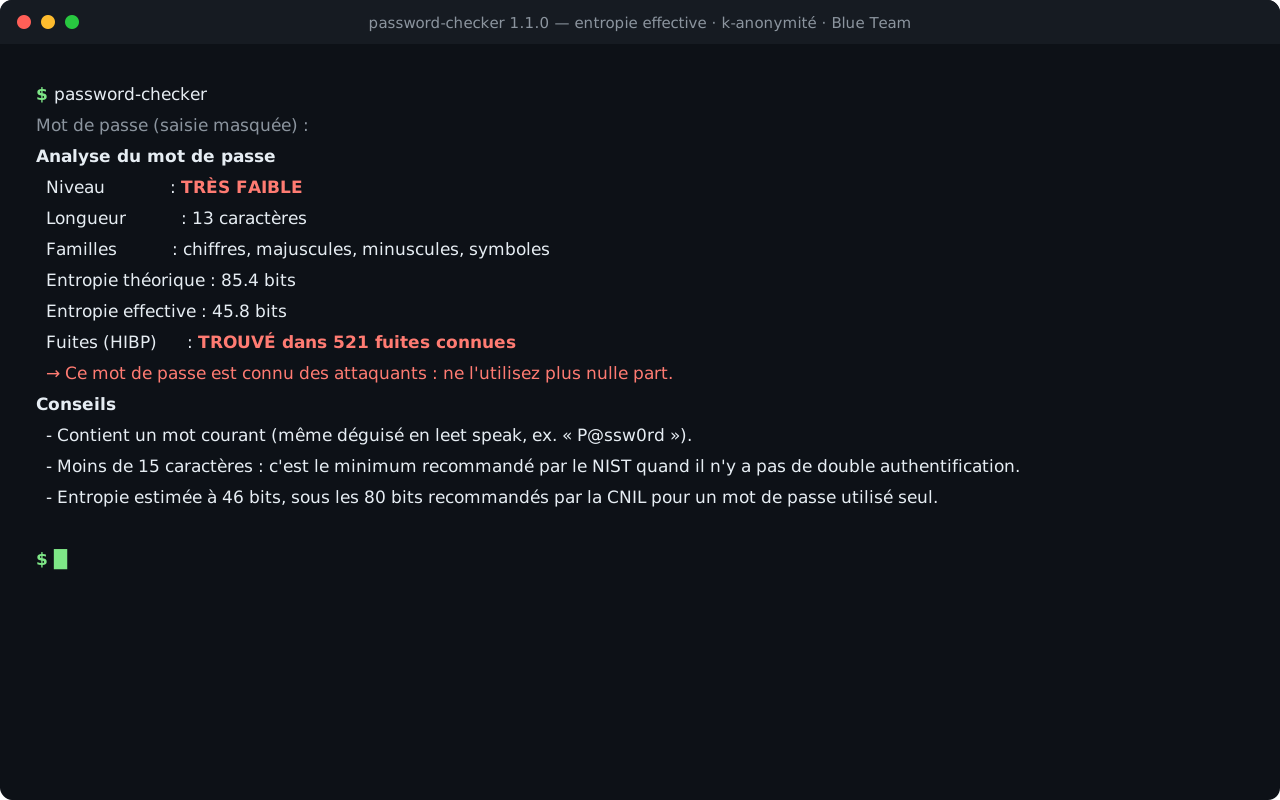
Personal project
Password Checker — strength & breach analyzer
Zero-dependency Python CLI and bilingual web app: effective entropy, weak-pattern detection and a k-anonymity breach check where only 5 hash characters leave the device
Context
I rebuilt this project from scratch to show a defensive, privacy-first approach to a classic problem: how strong is a password really, and has it already leaked? Character-count formulas overrate human passwords, and most online checkers ask you to trust them with the password itself. Password Checker estimates what an attacker would actually try first, and checks Have I Been Pwned without ever sending the password.
What I built
- A Python CLI (stdlib only): masked input, readable or JSON report, exit codes usable in scripts and CI
- Effective entropy: dictionary words (including leet speak such as P@ssw0rd), AZERTY/QWERTY keyboard walks, sequences and repetitions are scored as an attacker would guess them
- Thresholds sourced from France's CNIL (2022) and NIST SP 800-63B-4
- Breach check through the Pwned Passwords k-anonymity API: SHA-1 computed locally, only the 5-character prefix is sent, response padding enabled
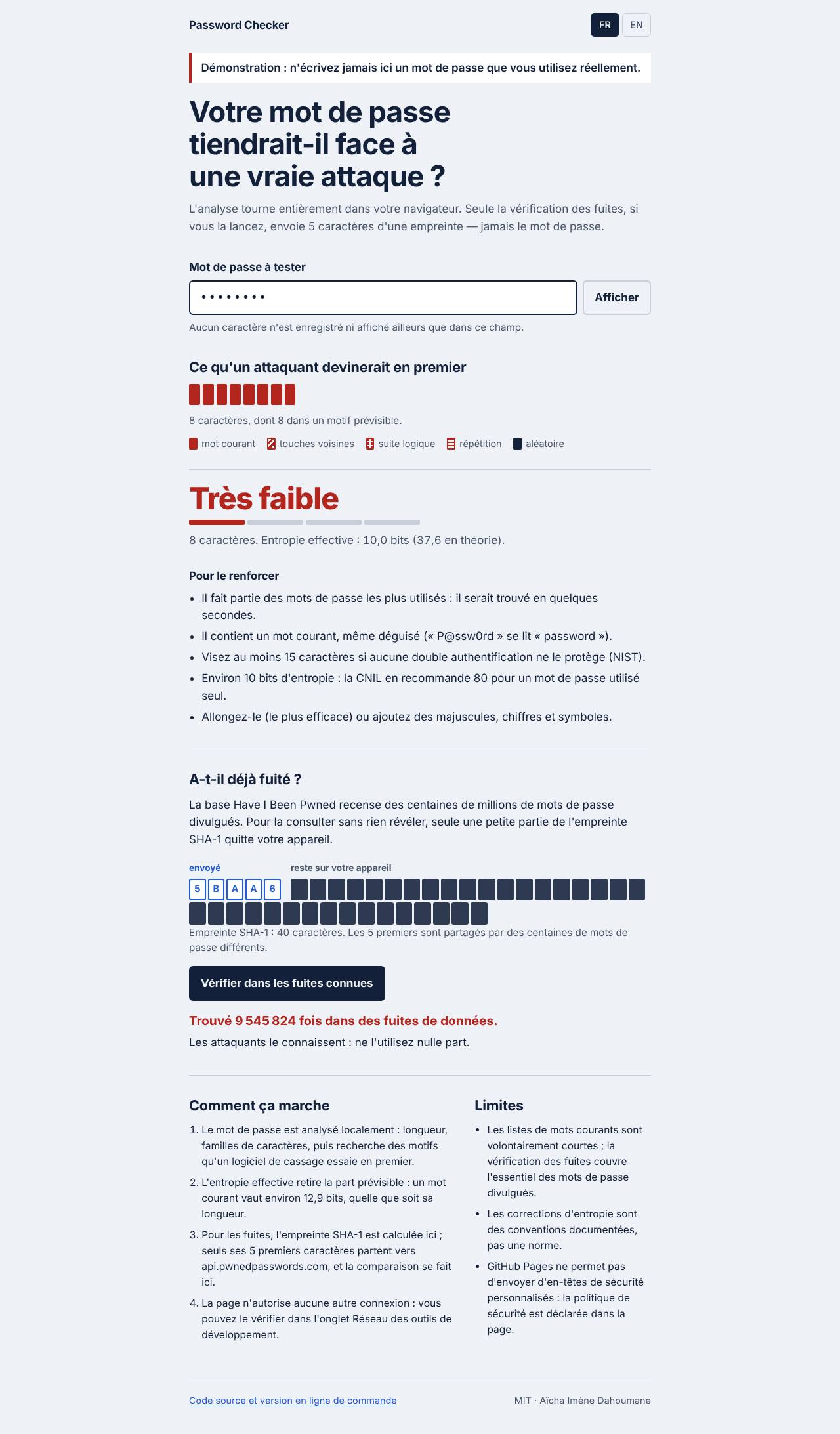
- A bilingual (EN/FR) web interface on GitHub Pages: a TypeScript port of the engine, a pattern map that never reveals a character, and the SHA-1 hash drawn as 5 sent cells and 35 kept cells
Security choices
- The password is never displayed, logged or stored; tests assert it never appears in any output
- No --password option: it would leak into shell history and process arguments
- Web: strict Content Security Policy allowing a single destination (api.pwnedpasswords.com), no analytics, no third-party scripts or fonts, no cookies sent
- Breach check on click only — checking on every keystroke would send the prefix of every partial password
- Repository hardening: protected main branch (PR + green CI required), secret scanning with push protection, Dependabot, private vulnerability reporting, Gitleaks scan of the full history
Engineering quality
77
Python tests
48
TypeScript tests
22
Shared test cases
both engines must return identical results
5 jobs
CI matrix
Windows + Linux, Python 3.11/3.14, Node 24
0
Runtime dependencies
How it works
- 1Local analysisLength and character classes give the theoretical entropy (L × log2 N).
- 2Pattern detectionCommon words, keyboard walks, sequences and repetitions are located — by type and position only, never by text.
- 3Effective entropyPredictable parts are re-scored (about 12.9 bits per common word) and the score follows CNIL thresholds.
- 4Breach checkSHA-1 is hashed locally; only its first 5 characters are sent, and the matching suffix is searched locally.
Links
Screenshots