
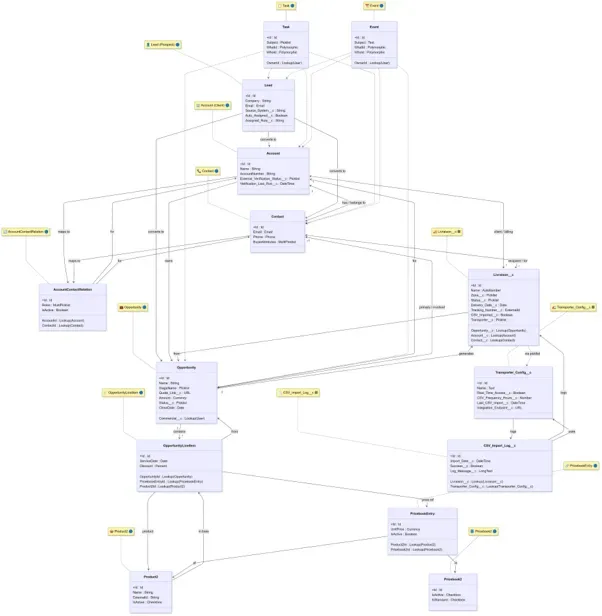
Delivery tracking CRM design (LTP)

Design of an Apex backend prototype for LTP (luxury & fashion): data model, security, import strategy.
Business context
Le Temps des Papillons (LTP) is a French bridal couture house. Its delivery tracking ran through 3 carriers with disparate interfaces, generating roughly 194 support calls a day — just to check a status.
For a bridal house, that status is not a routine question. A couture gown is tied to a wedding date that can't move: "we'll check and call you back" isn't an acceptable answer, and every one of those daily calls was a client anxious about a non-negotiable deadline. That urgency — multiplied across 2.1 million accounts and 3 carriers with no shared status format — is what made a unified view a business requirement, not a convenience.
The mission: design the complete technical architecture of the Salesforce application before any development — UML data model, security matrix, import strategy, and carrier integration plan. Functional target: a 70% cut in inbound calls through automation, and a 360° customer view.
Constraints and data volume
| Constraint | Figure / nature | Design consequence |
|---|---|---|
| Target data volume | 2,123,000 accounts · 3,239,870 contacts · 234,000 opportunities | Bulk import to sequence, no manual handling possible |
| 3 carriers, heterogeneous interfaces | 2 real-time REST APIs · 1 CSV/SFTP feed | Two distinct integration channels, imposed by the carriers — not a choice |
| Initial import with no loss or duplicates | Parent-child dependency order across 10 objects | Sequenced load plan + a uniqueness key (External Id) |
| Support target | −70% inbound calls | Status automation must be reliable, not "best effort" |
Architecture — two channels
The two-channel split is dictated by the carriers, not a design preference: LTP France and Transport Luxe Europe expose a REST API; Rapid International Transport only offers a CSV drop over SFTP.
─ Real-time channel (LTP France, Transport Luxe Europe) ────────────
  Carrier webhook
     ▼  @RestResource /delivery-webhook  (DeliveryWebhook class)
  Platform Event DeliveryEvent__e        (decouples receipt from processing)
     ▼
  record-triggered Flow → updates Livraison__c
  On-demand refresh: RefreshStatusQueueable
     · Limits.getCallouts() + auto re-enqueue when callouts are exhausted
     · DeliveryService / TransporterCalloutService (@future(callout=true))
  Display: deliveryTracker LWC + DeliveryController (isAccessible() before reads)

─ Batch channel (Rapid International Transport) ────────────────────
  SFTP drop every 2h
     ▼  Talend job: tSftpInput → tMap → tSalesforceOutputBulkExec
  Bulk API v2 · upsert on Tracking_Number__c (External Id) · 500,000 rows/h
     ▼
  Logged to CSV_Import_Log__c
Authentication via Named Credentials (OAuth2) on both sides, mandatory Remote Site Settings, callouts tested with HttpCalloutMock.
Zone-based security model
Three geographic zones (France / Europe / International), but a single "Support Agent" profile. Isolation is not handled by multiplying profiles:
- Role hierarchy (Manager → France / Europe / International) + sharing rules on
Zone__cfor zone-based data access. - OWD:
PrivateonLivraison__c,Public Read OnlyonAccount/Contact/Opportunity/Transporter_Config__c. - Targeted Field-Level Security:
Zone__cread-only for support (the zone filter is locked, not bypassable);CSV_Imported__cread-only on both sides (written only by Apex); financial fields (AnnualRevenue,ExpectedRevenue) masked from support. - Validation Rule blocking any "Delivered" status without a
Tracking_Number__c— tracking integrity is guaranteed at the source. - Point Permission Sets (
ReportingAccess,ImportControl,API_Access_Extension) to extend access without creating a profile.
Import strategy
- Load order respecting dependencies:
Product2→Pricebook2→PricebookEntry→Account→Contact→AccountContactRelation→Opportunity→OpportunityLineItem→Livraison__c→Transporter_Config__c. - Differentiated tools: Data Loader CLI for the initial import (50k-row batches); Talend + Bulk API v2 for carrier flows (500,000 rows/h, 10,000 records/request).
- Defined test scenarios: 500k-line CSV import on the Talend sandbox (< 15 min), simulated API timeout via
HttpCalloutMock, duplicate Tracking Numbers auto-merged via External Id. - Target coverage: ≥ 90% on integration Apex classes, 100% on error handlers.
- Governance: an "Import Monitor" dashboard (imports/day, rejection rate) + Flow/Apex email alerts on critical failure.
Architecture decisions (ADR)
| Decision | Alternative rejected | Why |
|---|---|---|
| Two integration channels (real-time REST + batch SFTP) | A single channel for all 3 carriers | Rapid International Transport exposes no REST API — a carrier constraint, not a preference |
| Platform Event between the webhook and processing | Synchronous processing in the REST endpoint | Decouples receipt (fast, always 200) from processing (Flow, updates); absorbs spikes |
| Isolation by roles + sharing rules, a single profile | One profile per zone | One profile to maintain; sharing is enough as long as zones only differ in data visibility |
Upsert on External Id (Tracking_Number__c) | Insert + after-the-fact dedup | Idempotency: replaying the same file creates no duplicate |
| Prototype and specification, no go-live | Develop straight away | The expected deliverable was a justified architecture — coding before the security model was settled would have been premature |
Assumed limitations
- No reconciliation between the two channels. If a batch import lands after a real-time webhook already updated the same delivery, the batch write can overwrite a fresher status. Acceptable at a 2h SFTP cadence for this carrier's volume — but it's the first gap to close before increasing batch frequency.
- The single profile relies entirely on the role hierarchy and sharing. Any future zone needing a genuinely different permission set (not just different visibility) would require restructuring the role hierarchy.
- Architecture validated on its design merits, never load-tested against the target 2.1M accounts. This is a specification and a prototype — not a system proven at production scale.
Results
| Metric | Value |
|---|---|
| Target production data volume | 2.1M accounts |
| Carriers integrated | 3 (2 real-time REST APIs + 1 batch CSV/Talend) |
| Custom objects designed (UML model) | 5 |
| RNCP diploma evaluation | 4/4 competencies validated |
What this project demonstrates
Architecture work, not development: designing the data model, security and integration before writing code, and being able to defend every choice. A security model that scales through the role hierarchy, not through profile proliferation. And clear honesty about the line between what is designed and what is proven — a credible architect names that line rather than hiding it.
The context itself is representative of the luxury sector: traceability where a missed date is not an inconvenience but a client incident, and where tracking can't be "roughly right".
Fil-rouge project from the RNCP Level 6 "Développeur Concepteur Logiciel" diploma (OpenClassrooms): imposed context, dataset and constraints, deliverable defended before a jury. It is expanded here with the architecture / security / governance reading expected in a professional context — beyond the strict scope of the exercise.
Screenshots
