Apex backend development (iDEM Connect)

Development of an Apex backend for iDEM Connect: trigger, service classes and batch scheduler.
Business context
iDEM Connect is an international internet service provider (€1.8B revenue, 3,950 employees). The goal: equip the sales force on Salesforce around the Account / Contract / Order triad, with three precise business rules and a strict test coverage requirement stated up front in the spec.
The mission wasn't just to "make it work": it was to design the architecture (trigger, handlers, batch, scheduler), implement it cleanly, and deliver usable technical documentation — one fact sheet per class and a traceability matrix linking every requirement to its tests.
The three business rules
| # | Rule | Technical trigger |
|---|---|---|
| RG-01 | Forbid activating an order with no order line | Draft → Activated transition intercepted on OrderTrigger.before update; aggregate COUNT(OrderItem) per Order; blocking addError() if the count is zero |
| RG-02 | Keep Account.Active__c in sync with order existence | true on order insert (after insert); false only when the account's last remaining order is deleted (after delete) |
| RG-03 | Automatically re-engage dormant accounts | Every 1st Monday of the month at 9am (CRON 0 0 9 ? * MON#1): a batch creates a J+5 "Call" task for every account with no order and no existing "Call" task |
Architecture
One trigger per object, zero logic in the trigger. OrderTrigger only orchestrates the handler calls — it holds no business rule, which makes it bulk-safe by construction and testable handler by handler.
OrderTrigger  (orchestration only)
  ├─ before update → OrderValidationHandler   (RG-01 — read-only, addError)
  ├─ after  insert → OrderInsertionHandler    (RG-02 — Account.Active__c = true)
  └─ after  delete → OrderDeletionHandler     (RG-02 — Account.Active__c = false if last)

AccountReminderScheduler  (monthly CRON)  →  AccountReminderBatch  (RG-03)
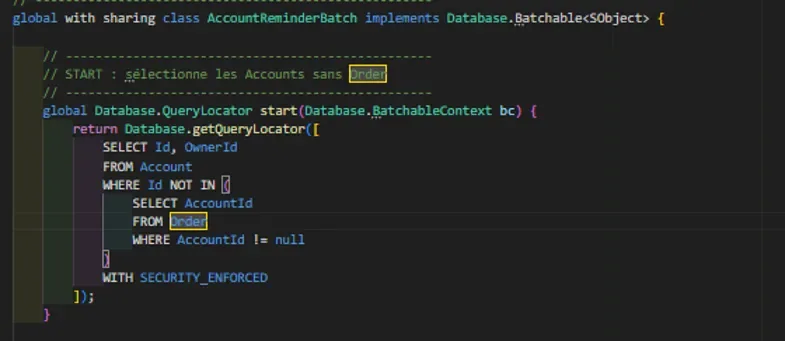
  start()   : SOQL anti-join — accounts with no order
  execute() : GROUP BY WhatId dedup aggregate, "Call" task creation
  finish()  : run log

AppConfig         — every business constant (statuses, labels, J+5 delay)
TestDataFactory   — test data factory (generateX() no DML / createX() with DML)
Architecture decisions (ADR)
| Decision | Alternative rejected | Why |
|---|---|---|
| Handler pattern, logic outside the trigger | Logic directly in OrderTrigger | Bulk-safe by construction, each rule tested in isolation, explicit execution order |
AppConfig class for configuration | Custom Metadata Type / Permission Set | At this scale (a single org), simpler to audit; would migrate to a Custom Metadata Type on a multi-environment project — a deliberate choice, not an oversight |
Database.insert/update(..., allOrNone = false) | allOrNone = true (full rollback) | One bad row must not cancel the re-engagement of 200 other accounts; partial failures are logged in detail |
Dedup driven by a flag (DEDUPE_USING_AUTO_FLAG) | Hard-coded behavior | The business can choose "any Call task blocks the reminder" or "only auto-created ones" without touching the batch |
| Fallback to the running user in the scheduler | Fail if the account owner is inactive | A deactivated owner must not break a scheduled monthly reminder |
Security by design
Security isn't a final pass — it's applied query by query, with the right tool for each case:
WITH SECURITY_ENFORCEDon the batch's anti-join: a simple, eligible query — FLS checking is delegated to the platform.- Explicit CRUD/FLS checks on the dedup aggregate: a
GROUP BYis not eligible forWITH SECURITY_ENFORCED, soSchema.sObjectType.Task.isAccessible()and access to theWhatId/Subject/Auto_Created__cfields are checked by hand before running it. Knowing that platform limitation is the difference between "I putWITH SECURITY_ENFORCEDeverywhere" and security that actually holds. Security.stripInaccessible(CREATABLE)before every task insert,(UPDATABLE)before every account update: fields the running user can't access are silently stripped instead of throwing.- Strict bulkification: no SOQL or DML inside a loop, everything via
Set/Mapand aggregates. Validated by a test processing 250 accounts in a single transaction — here bulkification is a robustness property as much as a performance one.
Tests, traceability & deployment
- 23 unit tests covering the nominal case, edge cases, error cases and the 250-account bulk, all built via
TestDataFactory(decoupled data reused across the 6 test classes). - 90% org-wide coverage,
OrderTrigger/AppConfig/AccountReminderSchedulerat 100%; the densest class (AccountReminderBatch— dedup + owner fallback + resilient insert) at 86%, a figure documented per class rather than smoothed over. - Requirements-to-tests traceability matrix: every business rule points to the test methods that cover it — a reviewer finds in one line which test validates RG-02.
- Deployment via Salesforce DX (
sfdx force:source:deploy), versioned metadata.
Assumed limitations
- RG-01 only covers the
Draft → Activatedtransition. An order moving straight fromCancelledtoActivatedwould bypass the check. Documented rather than fixed out of scope, with the fix path identified (broadening the transition condition inOrderValidationHandler). - Configuration in an Apex class, not Custom Metadata: see the ADR — acceptable for a single org, to evolve before a multi-environment deployment.
- No retry mechanism for tasks not created due to a partial failure: they're logged, not automatically re-attempted.
Results
| Metric | Value |
|---|---|
| Business rules implemented | 3 / 3 |
| Unit tests | 23, 100% pass rate |
| Org-wide coverage | 90% (3 classes at 100%) |
| Load test | 250 accounts processed in one transaction |
| RNCP diploma evaluation | 3/3 competencies validated — distinction, architecture judged clean and well documented |
What this project demonstrates
Not "the code compiles": a Salesforce backend where the security model is enforced end to end, where a partial failure doesn't bring down a bulk job, and where every business rule is isolated, tested and traced. It's the kind of backend an architect reviews without having to rewrite it — the exact difference between a beginner's deliverable and a production one.
Fil-rouge project from the RNCP Level 6 "Développeur Concepteur Logiciel" diploma (OpenClassrooms): imposed context, dataset and constraints, deliverable defended before a jury. It is expanded here with the security, robustness and traceability layer expected in a professional context — beyond the strict scope of the exercise.
Screenshots