Apex backend optimization (FASHA)

Taking over FASHA's Apex backend (training scenario): two bugs diagnosed down to root cause (a trigger that breaks at 100 orders, a calculation that silently fails on bulk import), a full refactor into a bulk-safe handler pattern, the weekly batch moved to async, >85% coverage.
Context
FASHA, a multinational clothing distributor (350 employees, Europe / US / APAC), managed accounts, contacts and orders on Salesforce. The app was slowing down and accumulating bugs.
The project scenario: diagnose, fix and reorganize an existing Apex backend. Not greenfield — legacy code, described as in production in the scenario, where every defect hits the sales reps.
The two bugs — and their root cause
This is the core of the project: not just fixing, but understanding why.
Bug 1 — the trigger breaks past 100 orders
The UpdateAccountCA trigger threw an error whenever a sales rep updated an order on an account that had 100 orders or more.
100 is not a coincidence: it's the Salesforce governor limit of 100 SOQL queries per transaction. The trigger was firing a query per record instead of one bulk query — it worked while an account stayed small, then crossed the limit all at once. Non-bulk-safe by nature.
Bug 2 — the calculation is silently wrong on bulk import
The NetAmount__c field (= TotalAmount − ShipmentCost) recalculated fine when a rep added a line from the UI. But during a Data Loader import, only the first order in the batch was updated.
Root cause: the logic implicitly processed a single record (a Trigger.new[0] pattern), not a collection. From the UI, Trigger.new holds 1 row — the bug is invisible. Data Loader sends batches of 200 — the bug passes silently, with no error.
And the rest
- The weekly revenue recalculation job (after product price updates) ran for several hours synchronously — an architecture problem, not a tuning one.
- Disorganized code: no naming conventions, overly long classes, business logic in the triggers.
- Tests existed but were unreliable: they didn't actually validate results.
The refactor
| Before | After |
|---|---|
Logic in OrderTrigger | OrderTriggerHandler + TriggerHelper — one trigger per object, zero logic inside |
NetAmount over a single record | Collection-based recalc — identical via the UI or a 200-row import |
| Synchronous revenue update, blocks the rep's save | AccountService via @future — the user transaction no longer waits |
| Synchronous revenue recalculation, several hours | UpdateAllAccountsBatch + UpdateAllAccountsScheduler (Sunday 10pm) |
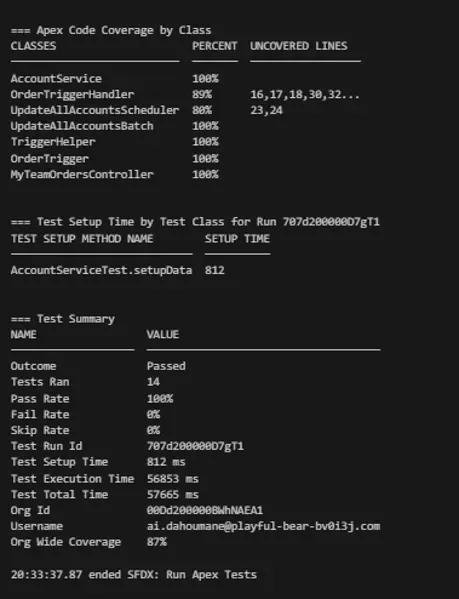
| Unreliable tests | TestDataFactory + @testSetup, >85% coverage, nominal / edge / error cases per class |
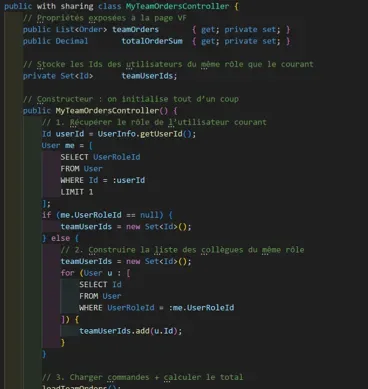
On top of the fixes: MyTeamOrdersController — a new controller displaying orders for a whole team (same UserRoleId), a feature requested by the sponsor.
Bulk-safe by construction
The key point: the refactor doesn't fix two bugs, it makes this class of bug impossible.
- 0 SOQL or DML inside a loop — everything via
Set/Mapand aggregates. Bug 1 can't recur, whatever the order count. - Collection-based processing throughout — bug 2 can't recur; the UI and bulk paths are the same path.
- Async where the work is heavy —
@futureto avoid blocking the user,Batchable+Schedulablefor scheduled bulk. - Tests that validate results, including a dedicated regression for each of the two original bugs (200+ row import, account with 100+ orders).
Architecture decisions (ADR)
| Decision | Alternative rejected | Why |
|---|---|---|
@future for the one-off revenue update | Synchronous processing | Don't make the rep wait on their save; the recalc doesn't need to be immediate |
Batchable + Schedulable for the global recalc | Keep the synchronous job, tune it | A multi-hour job is an execution-model problem, not a query-performance one |
| Handler pattern | Fix the logic in place in the trigger | Make the code testable and bulk-safe by construction, not patch by patch |
| Full weekly recalculation | Incremental recalc on changed accounts only | Enough at FASHA's volume; incremental would be the next step at much larger scale |
Assumed limitations
- >85% coverage, not 100% — well above the Salesforce threshold (75%), but a few rare error branches remain uncovered.
@futurehas its own limits (50 calls / transaction, no chaining) — no impact at current volume, but a move to Queueable would be worth considering if load grows.- Brute-force global recalculation — crude but reliable; incremental logic would become necessary well beyond current volume.
- Refactor scoped to the reported area, not a full audit of the whole org.
Results
| Metric | Value |
|---|---|
| Bugs fixed (root cause documented) | 2 (non-bulk-safe trigger · wrong calc on import) |
| SOQL / DML in loops, after the refactor | 0 |
| Test coverage | >85% (start: unreliable tests) |
| Weekly recalculation | multi-hour synchronous job → scheduled Batch Apex |
| RNCP diploma evaluation | 2/2 competencies validated — distinction, complete and well-justified fixes |
What this project demonstrates
The daily skill of a mid/senior Salesforce developer: taking over a legacy Apex backend and making it production-grade. A diagnosis that goes to root cause (knowing why 100, not just "it crashes"), understanding trigger context vs bulk import, a multi-hour job moved to async, and a refactor that stops the bug class from coming back.
Fil-rouge project from the RNCP Level 6 "Développeur Concepteur Logiciel" diploma (OpenClassrooms): existing code, bugs and constraints imposed, deliverable defended before a jury. It is expanded here with the root-cause-diagnosis / governor-limits / execution-model / regression reading expected in a professional context — beyond the strict scope of the exercise.
Screenshots