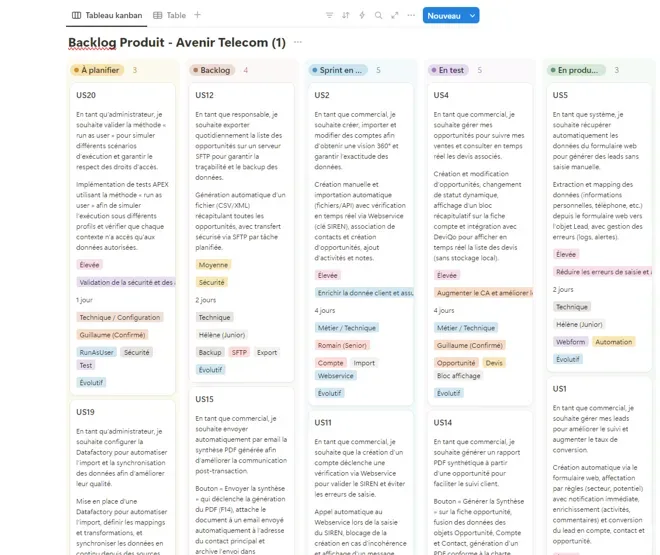

Lightning app delivery & backlog (Avenir Télécom)
Creation of a Lightning application for Avenir Télécom: backlog, testing and CRM interface migration.
Context
Following an internal audit, Avenir Télécom's South-zone sales teams needed a Salesforce Lightning app better aligned with their daily work (leads, accounts, opportunities, quotes).
The mission wasn't to code the app but to define and equip its delivery: an implementation strategy for a small 3-person Salesforce dev team, a costed product backlog, a test plan, a best-practices reference — then, from the feedback of a 3-month pilot simulated by the scenario, consolidating the feedback into a prioritized evolutions backlog.
The scenario's team: a senior developer (Apex & API integrations), a mid-level developer (automation & workflows) and a junior developer (UI/UX, testing, documentation).
The product backlog (Scrum)
20 user stories written, costed and prioritized, with acceptance criteria and prerequisites. The most structuring ones:
| User story | What it requires | Effort · dev |
|---|---|---|
| US1 — Lead management | Auto creation (web form), rule-based assignment (sector, potential) + immediate notification, conversion without data loss | 4 d · Senior |
| US2 / US11 — SIREN verification | Webservice call in real time on account creation; blocked + explicit error message on inconsistency | 4+2 d · Senior |
| US4 / US9 — DeviQo quotes | Real-time integration with the DeviQo API, quotes shown in < 2 s, no local storage, auto-refresh | 4+2 d · Mid |
| US14 / US15 — PDF + email | Summary PDF generation (merging Opportunity/Account/Contact), auto email to the primary contact, send archived | 2+2 d · Junior |
| US13 — GDPR purge | Scheduled job deleting accounts/contacts inactive > 3 years, with an audit log | 3 d · Mid |
| US18 / US20 — Dev Org hardening | Profile/access-rights config + Apex run as user tests validating each profile only accesses authorized data | 2+1 d · Senior/Mid |
| US19 — Datafactory | Automating import and continuous sync from external sources | 2 d · Mid |
The costing isn't decorative: every story is estimated and assigned to the right seniority level — API integrations and security go to the senior, automation to the mid-level, UI and tests to the junior. That's what makes the sprint plan sustainable rather than optimistic.
The test plan & the Apex reference
The test plan (20 classes: TestLeadsCRUD, TestComptesImport, TestOpportunites, TestRunAsUser, TestSuppressionRGPD…) comes with an Apex best-practices reference — a team standard, not a checklist:
- Systematic bulkification: no SOQL or DML inside a loop, collections everywhere (
List/Set/Map). - One trigger per object, logic delegated to handlers — One Trigger Framework + Service Layer pattern.
- Configuration externalized to Custom Settings / Custom Metadata instead of hardcoded.
- Async matched to the use case: Batch Apex (large volumes), Queueable (sequencing), Future (external calls), Scheduled (periodic).
- Security: systematic
with sharing, CRUD/FLS checks in data-access methods. - Minimum required coverage: ≥ 75%.
Security, from the backlog
Security isn't an end-of-project workstream — it's in the user stories:
- US13 — the GDPR purge is a story in its own right, with an audit log, not an improvised manual cleanup.
- US18 / US20 — the Apex
run as usertests actually validate profile isolation: each profile is put under test to prove it only sees its own data. That's a test, not an assumption. with sharingand CRUD/FLS checks written into the reference, so applied by construction.
From pilot to evolutions backlog
The scenario then simulates a 3-month pilot with the South-zone field teams: the feedback provided by the brief was consolidated into a prioritized Kanban backlog, with WIP limits and Notion documentation dynamically linking product backlog ↔ test plan ↔ evolutions backlog:
- 3 evolutions — E1 two-way interface with the CaseIn request-management tool · E2 automatic daily backup to a dedicated SFTP · E3 Dev Org config hardening.
- 3 fixes — C1 account sync via SIREN Webservice · C2 standardized opportunity naming format · C3 immediate rep notification on lead assignment.
- 3 bugs reported by the simulated pilot — B001 broken lead → opportunity conversion (high priority) · B002 incorrect imported account data · B003 assignment notifications not sending (fixed).
The loop is closed: a bug reported by the pilot (B003) links to fix C3, which links back to story US1. A reviewer can follow the thread.
Decisions & assumed limitations
| Decision | Alternative rejected | Why |
|---|---|---|
| Costing by seniority level | Story-level estimates with no assignment | A sprint plan is only realistic if the effort is carried by the right profile |
| Documented Apex reference up front | Best practices "everyone knows" | A written standard can be reviewed and enforced; an implicit one drifts |
| DeviQo quotes with no local storage | Local quote cache | A displayed quote must be the current quote — not a possibly stale copy |
| 3-month pilot before rollout | Direct generalization after dev | Bugs B001–B003 only surface in real use; the pilot is the safety net |
Assumed limitations:
- The product backlog is a costed specification, not an end-to-end executed deliverable — the value is in the quality of the framing and the test plan, tested against the feedback of a simulated pilot, not in a rollout across all of Avenir Télécom.
- B002 (incorrect imported account data) is tracked but not resolved within scope: identified, prioritized, left to the next sprint — flagged rather than hidden.
Results
| Metric | Value |
|---|---|
| Costed & prioritized user stories | 20 |
| Test classes (required coverage ≥ 75%) | 20 |
| Pilot duration set by the scenario | 3 months |
| RNCP diploma evaluation | 4/4 competencies validated |
What this project demonstrates
Not code depth, but delivery discipline: framing a scope, costing it and assigning it to the right level, writing a test plan that becomes a team standard, and closing the pilot → evolutions loop with full traceability. It's the dimension most often missing from a junior portfolio — and it's visible here, with the artefacts to back it.
Fil-rouge project from the RNCP Level 6 "Développeur Concepteur Logiciel" diploma (OpenClassrooms): imposed context, team and constraints, deliverable defended before a jury. It is expanded here with the team-strategy / testing / security-by-design / feedback-loop reading expected in a professional context — beyond the strict scope of the exercise.
Screenshots